Sustainable Development in the EU: 2017 monitoring report

Schermata 2017-12-19 alle 11.59.51

On 20 November, the Statistical Office of the European Union (EUROSTAT) published the 2017 edition of “Sustainable Development in the European Union“, its monitoring report on the state of the EU progress towards the Sustainable Development Goals (SDGs).

The Report is the first to come out since the European Commission adopted its Communication (COM(2016) 739) on “Next Steps for a Sustainable European Future“, which maps the alignment of current EU policies with the SDG framework and provides for regular monitoring of progress. EUROSTAT has selected a subset of SDG indicators (100 out of 232) which are closely linked to the Communication, as well as to the accompanying document “Key European action supporting the 2030 Agenda and the Sustainable Development Goals“. For those indicators (16) to which a current EU policy target is associated, the Report explores the EU progress towards that target, whereas all other indicators are monitored according to the direction and speed of change. Progress at the goal level is then measured as an average of progress of individual indicators under the specific SDG.

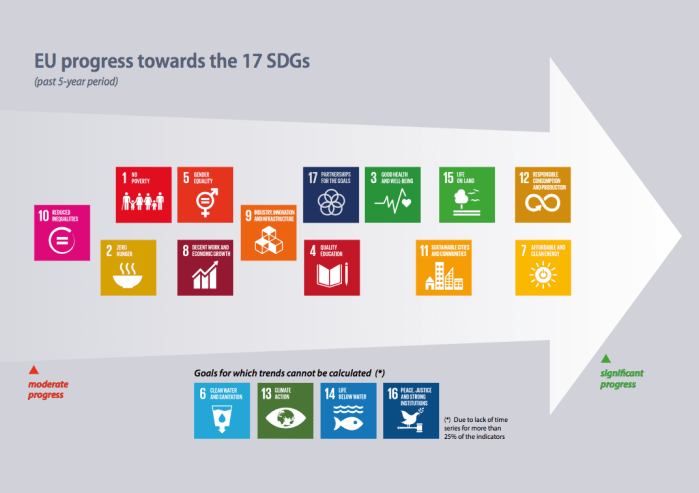
According to the Statistical Office, in a five-year time span the European Union has made progress towards all SDGs, even though instances where the member States have moved away from a sustainable development trajectory are also evident within individual goals.  In particular, significant progress has been achieved for SDG 3 (Good Health and Wellbeing), SDG 7 (Affordable and Clean Energy), SDG 11 (Sustainable Cities and Communities), SDG 12 (Responsible Consumption and Production) and SDG 15 (Life on Land).

This does not necessarily indicate that the status of the goal has already reached a satisfactory level for the EU. For example, progress on the conservation of terrestrial ecosystems under SDG15 does not mean that ecosystems and biodiversity across the member States are in good health. In addition, there have been only moderate advancements for eight SDGs, with SDG 10 (Reduced Inequalities) lagging far behind the others. Finally, for four SDGs (including SDG 6, Clean Water and Sanitation, SDG 13, Climate Action, SDG 14, Life Below Water, and SDG 16, Peace, Justice and Strong Institutions), EUROSTAT concludes that it has been impossible to evaluate trends due to insufficient data, something which is particularly worrying in the context of fundamental challenges such as climate change, degradation of marine ecosystems, and a rising authoritarian wave in the European continent.

To read all the key trends and statistics from the Report, download it here


New Keynote Lecture Announced: Prof. Barbara Pozzo on the trajectory of environmental damage in Europe

1052_7_INSUBRIA_0233We are honoured to announce a new guest for our 2017/2018 EULawSD Keynote Lecture Series. Prof. Barbara Pozzo, among Europe’s leading experts on private and comparative environmental law, will deliver a lecture on “The Trajectory of Environmental Damage in Europe” on Friday, 23 March 2018 at 10:00 CET.

Prof. Barbara Pozzo is Professor of Comparative Law at the Faculty of Law of the University of Insubria in Como (Italy) since 2001, where she teaches Comparative Legal Systems, Comparative Law and Language and Legal Translation. She is the Director of the Summer School Program in Comparative Environmental Law, in association with UC Davis Law School, and approved by the American Bar Association. Since 2002, Prof. Pozzo is also the Director of the Ph. D. Program in Comparative Law at the University of Milan, where she has also served as the Director of the Master Program in Environmental Law (since 2001 and until 2010).

Prof. Pozzo has been visiting professor at the University of Hamburg, Montpellier, Louisiana State University, Fordham University, University of California at Davis, McGeorge School of Law at Pacific University, William S. Boyd School of Law at Nevada University. She is the Editor of two Series: Le Lingue del Diritto (The Languages of the Law) and Diritto ed Economia dell’Ambiente (Law and Economics of the Environment), both published by Giuffrè- Milan.

Prof. Pozzo has collaborated with various EU Institutions, such as Directorate General on Translation and Directorate General – Clima (Unit Adaptation) of the EU Commission, as well as with the EU Parliament.

EULawSD at Kick-off Meeting for New Jean Monnet Beneficiaries

Schermata 2017-11-16 alle 15.56.57

On 27-28 November, Prof. Riccardo Pavoni, in his quality of academic coordinator of the EULawSD module, will participate in Brussels in the kick-off meeting of new beneficiaries of Jean Monnet Activities (co-organised by EACEA).

The meeting will be organized together with the 2017 edition of the Jean Monnet biennial Conference (BiCo). This year’s edition will be devoted to the current major political turning point in EU history and its consequences for the future of the European integration. This theme has been very high on the agenda of political and academic debates recently and is about to gain even more relevance in the light of the Commission’s White Paper, the speech on the state of the union by president Juncker and also major political developments in EU member states in the course of 2017.

As a consequence, the conference objective is to allow debate on important EU-policy issues but also to disseminate information on more technical issues for the new grant holders.

For more information about the work programme, you can visit the event’s page at https://ec.europa.eu/education/events/2017-jean-monnet-bico_en.

New Keynote Lecture: Prof. Antonio Tanca on EU Crisis Management Policy

atancaWe are honoured to announce that we have managed to co-organize, in conjunction with the Chair of International Law of the University of Siena’s Department of Law (DGIUR), a further EULawSD keynote lecture on Thursday 16 November at 15:00 CET.


Prof. Antonio Tanca, former Head of Unit of the Council of the EU, will speak about “The EU Crisis Management Policy: Institutional Aspects and Main Missions and Operations“. The external action of the EU involving crisis management raises important sustainable development issues, such as the EU responsiveness to the humanitarian needs of developing countries, the EU capacity to address climate emergencies and natural disasters, and the EU contribution to the restoration of the rule of law in post-conflict societies. With March 2017’s Rome Declaration, the EU Member States have emphasized the need for the Union to play a more decisive global role in confronting situations of crisis and vulnerability, some of which have a direct bearing on  European neighborhood countries or exercise pressure on the EU external borders.

In the context of the Sendai Framework for Disaster Risk Reduction, adopted in March 2015 as the first major agreement of the post-2015 development framework of the United Nations, the EU external action on crisis management and disaster risk reduction also constitutes a key instrument for achieving the goals enshrined in the 2030 Agenda. The lecture thus represents a timely and valuable addition to the EULawSD module, and will be open to the public.

Book review of ‘Governing Through Goals’

9780262533195

The latest issue of Transnational Environmental Law (Volume 6 – Issue 3 – November 2017) features a new article by Dario Piselli and Riccardo Pavoni, Programme Manager and Academic Coordinator of the the Jean Monnet Module in European Union Law and Sustainable Development, respectively.

The article reviews ‘Governing Through Goals: Sustainable Development Goals as Governance Innovation‘, a compelling volume edited by Norichika Kanie (Senior Research Fellow at UNU-IAS) and Frank Biermann (Professor of Global Sustainability Governance at the Copernicus Institute of Sustainable Development) which analyses the challenges and opportunities of goal-setting as a governance strategy in the light of the adoption, in September 2015, of the 2030 Agenda for Sustainable Development.

Governing through Goals constitutes a compelling contribution to the academic study of the SDGs as a governance strategy and represents a timely reminder that the hard part of the game begins now. Two years after the UN Sustainable Development Summit, the pace of implementation of the SDGs is still insufficient to deliver on the promise of transformative change that surrounded their adoption.

More importantly, there are two inherent risks in wrongly assuming that goal setting alone will move the world towards sustainable development. One such risk is arguably the central concern of this book: that enthusiasm towards goal setting does not appear to be matched by a parallel political will to move away from ‘governance-as-usual’ and devise innovative arrangements to help in managing global public goods in the Anthropocene. The other is the risk of an inadequate level of country ownership of the SDGs, leading to developments at the national level that simply realign existing policies with the SDG framework or fail to effectively integrate the three dimensions of sustainable development.”

The book, published by MIT Press, is available here.
You can read the review here.

Two EULawSD Keynote Lectures Announced

The academic staff of the Jean Monnet Module in European Union Law and Sustainable Development is happy to announce that this year’s course programme will feature two keynote lectures, taking place on 1 and 7 December 2017, respectively.

Nerina_Boschiero_INTOn 1 December (11am – 1 pm), Prof. Nerina Boschiero will be at the Department of Law of the University of Siena to discuss “The Principle of Sustainable Development in International and European Union Law“. Boschiero is Professor of International Law at the University of Milan and Head of Studies of the LLM in Sustainable Development. Previously, she was professor of International Trade Law at the University of Milan (2002-2012), professor of International Law and Private International Law at the University of Verona (1997-2002), professor of International Law, Private International Law, European Law at the University of Catania (1994-1997), and lecturer of Private International Law at the University of Trento (1990-1992). Her current research interests are focused on the intersection and interaction between public and private international law.

mGestriOn 7 December (10am – 12pm), Prof. Marco Gestri will instead deliver his keynote lecture on “The Precautionary Principle in International and European Union Law”. Gestri is Professor of International Law and Director of the Center for Research on the European Union, University of Modena and Reggio Emilia. He is the Scientific Director of the Renzo Imbeni Summer School, Modena; a member of the Board of Editors and Book Reviews editor of the Italian Yearbook of International Law; and sits on the Scientific Committee of Diritto dell’economia and of Security: Theory and Practice. Prof. Gestri is also a fellow at the Istituto Affari Internazionali, the International Institute of Humanitarian Law, and the Italian Society of International Law.
The keynote lectures of the EULawSD Module will be public events aimed at exposing the course participants to a leading figure (scholar, expert or practitioner) in EU law and sustainable development, which will touch on the most relevant issues and challenges in the field while also focusing on key themes that will be different each year. The 2-hour lectures will build interest on the topic of the course but also more generally raise awareness among the general public about the importance of the EU in realizing the vision of the 2030 Agenda for Sustainable Development. The lectures will be hosted by the Department of Law of the University of Siena (via P.A. Mattioli 10, 53100 Siena, Italy).

Publication of ASviS Report 2017

On September 28th, the Italian Alliance for Sustainable Development (ASviS) launched its 2017 Report on “Italy and the Sustainable Development Goals” during a meeting at the Italian Chamber of Deputies.

img_rapporto_asvis2017The Report has three main components. First, it presents an assessment of Italy’s progress in the implementation of the SDGs. Second, it details a list of concrete proposals for the Italian government to consider in the next budget law and in subsequent policy developments. Finally, it proposes an innovative analytical model to forecast possible pathways for sustainable development in Italy based on a series of different policy scenarios to 2030.

With respect to the role of the EU, the 2017 Report argues that after its decisive contribution to the negotiation of the 2030 Agenda for Sustainable Development, the European Union has not moved fast enough to enshrine the SDGs in its own analytical and political processes. ASViS emphasizes that the implementation of the Agenda represents a major opportunity for anchoring the European vision to the challenges of the 21st century, and should be at the center of both the revision of the Europe 2020 Strategy and the political debate around the 2019 European Parliament’s elections. From this perspective, the Parliament and Council’s responses to the European Commission’s Communication on a new European Action for Sustainability signal the need for a change of pace, and accordingly invite the Commission itself to develop a coherent strategy, a clear timeline and a global gap analysis that can support bolder ambitions towards the achievement of the Goals.

During the event, ASviS (a network of over 170 institutions and civil society organizations working to promote the implementation of the SDGs in Italy) also presented the new ASviS open-access database, which includes information on more than 170 SDG indicators and allows for easy data visualization and comparison across different time spans and spatial scales.

Download the Report (Pdf)
Synthesis
Executive Summary (Italiano)
Executive Summary (English)
Learn more about the ASviS Database
Learn more about the SDG Indicators


EULawSD sulla Guida di Dipartimento 2017/2018

DIPARTIMENTO-DI-GIURISPRUDENZA

Le informazioni relative al corso di Diritto dell’Unione Europea e Sviluppo Sostenibile (EULawSD) sono adesso disponibili sulla Guida dello Studente 2017/2018 del Dipartimento di Giurisprudenza dell’Università degli Studi di Siena.

Il corso, co-finanziato dall’Unione Europea quale Modulo Jean Monnet (Erasmus+ Call for Proposals 2017 – EAC/A03/2016), esamina la relazione tra l’ordinamento giuridico dell’Unione Europea e il concetto di sviluppo sostenibile nelle sue quattro dimensioni (economica, sociale, ambientale e di governance) e alla luce dell’Agenda 2030 e relativi Obiettivi per lo Sviluppo Sostenibile (Sustainable Development Goals) approvati dall’Assemblea Generale delle Nazioni Unite il 25 settembre 2015.

Il corso offre agli studenti la possibilità di approfondire le loro conoscenze in materia di diritto dello sviluppo sostenibile alla luce del quadro giuridico internazionale ed europeo, ed illustra in particolar modo l’azione interna ed esterna dell’Unione Europea rilevante per l’attuazione degli Obiettivi per lo Sviluppo Sostenibile delle Nazioni Unite.

Per saperne di più, è possibile prendere visione della Guida al seguente indirizzo: https://www.dgiur.unisi.it/sites/st05/files/allegatiparagrafo/27-07-2017/notiziario_2017.2018_giurisprudenza_0.pdf

EULawSD Module selected for co-funding by EACEA

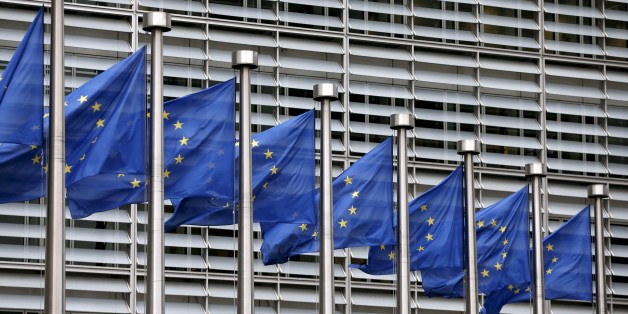
File picture shows European Union flags fluttering outside the EU Commission headquarters in Brussels
Credit: REUTERS/Francois Lenoir/Files

On 26 July 2017, the Education, Audiovisuals and Culture Executive Agency (EACEA) of the European Commission announced the results of its annual call for co-funding of Jean Monnet Activities under the Erasmus+ Programme (Call EAC/A03/2016).

Among the 833 proposals received by the EACEA for Jean Monnet teaching and research activities, 141 were selected for funding. The proposal for a module on “European Union Law and Sustainable Development” (EULawSD), presented by Prof. Riccardo Pavoni of the University of Siena together with Mr. Dario Piselli (Graduate Institute of International and Development Studies), Prof. Sonia Carmignani, Prof. Federico Lenzerini, Prof. Patrizia Vigni and Prof. Alessandro Palmieri (all of the University of Siena), was one of them. The project activities will now be hosted by the Department of Law of the University of Siena and implemented over the course of three years.

EULawSD seeks to explore the ever-expanding corpus of European Union Law relating to sustainable development, with an emphasis on its interactions with the 2030 Agenda for Sustainable Development adopted by the United Nations in September 2015. The module will consist of an annual 40-hour course primarily aimed at students of the Single Cycle Degree Programme in Law at the University of Siena, but also open to students from the Political Sciences, Humanities and Social Sciences departments. The course will be complemented, on an annual basis, by a keynote opening lecture, a final expert roundtable, a dedicated website, and a series of webinars.

For more information, contact us via the dedicated contact form on this website.
For the full selection results, visit https://eacea.ec.europa.eu/erasmus-plus/news/jean-monnet-activities-2017-call-eaca032016-0_en.